
Table of Contents
Computer Science
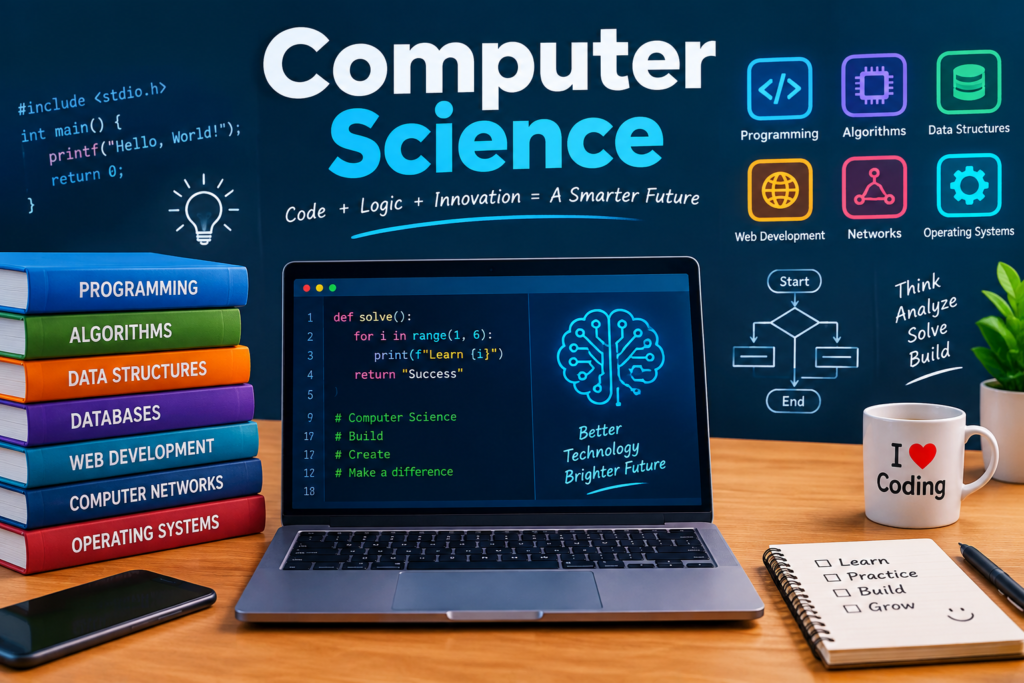
Computer science is the study of computers, software, data, and the methods used to solve problems with technology. It is not only about using a computer or learning how to code. Computer science also teaches us how to think logically, solve problems, organize information, and create useful digital solutions.Today, computer science is connected to almost every part of our lives. We use computers and technology for education, communication, banking, shopping, entertainment, healthcare, business, and many other activities.
What Are the Basics of Computer Science?
The basics of computer science include understanding how computers work, how data is stored and processed, and how instructions are given to a computer.
A computer follows instructions to perform different tasks. These instructions are usually provided through software and programs. Computer science also involves problem-solving, algorithms, programming, databases, networks, and cybersecurity.Learning these basic concepts gives beginners a strong foundation before moving into advanced areas of technology
Hardware vs. Software
Two important terms in computer science are hardware and software.
Hardware refers to the physical parts of a computer that we can see and touch. Examples include the keyboard, mouse, monitor, processor, RAM, hard drive, and motherboard.Software is a collection of programs and instructions that tell hardware what to do. Examples include operating systems, web browsers, mobile applications, and video-editing software.
In simple terms, hardware is the physical equipment, while software provides the instructions. All of these make the computer useful.
How Does a Computer Work?
A Computer generally works through four basic stages: input, processing, storage, and output.
Input is the information provided to a computer. For example, when you type something using a keyboard, you are providing input.
Processing happens when the computer’s processor works with the information according to specific instructions.
Storage allows the computer to save information for future use. Files, photos, videos, and programs can be stored on storage devices.
Finally, output is the result produced by the computer. A result may appear on a monitor, come through speakers, or berinted on paper.
What Is Programming?
Programming is the process of creating instructions that a computer can understand and execute; the person who writes these instructions is called a programmer.
Programming languages provide a way for humans to communicate instructions to computers. Some popular programming languages include Python, Java, JavaScript, C, and C++.
For example, a programmer can create instructions that tell a computer to calculate numbers, display information, operate a website, or process data.
Programming is an important part of computer science, but computer science is broader than programming alone.
What Is an Algorithm?
An algorithm is a step-by-step guide for solving a problem or completing
We use algorithms in everyday life without always realizing it. For example, following steps to prepare a cup of tea can be considered a simple process.
What Is Data?
Data means information that can be collected, stored, processed, and analyzed by a computer.
Data can include names, numbers, text, images, audio, videos, and many other types of information. For example, an online store
information about products, customers, orders, and payments.
Computers process data to produce useful information. Understanding data is important because modern applications and websites handle huge amounts of information every day.
What Are Computer Networks?
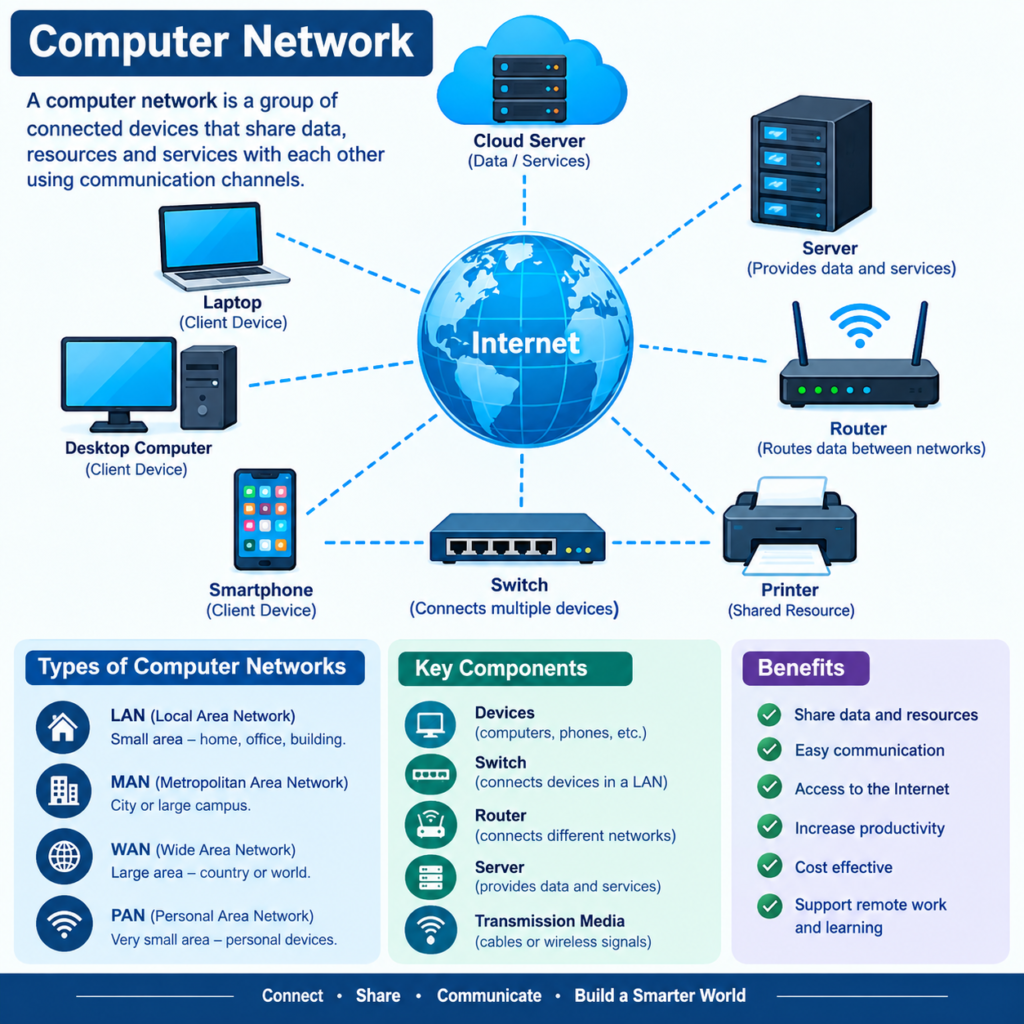
computer network allows two or more computing devices to communicate and exchange information
A simple home network might connect smartphones, laptops, smart TVs, printers, and other devices.
Larger networks can connect computers across buildings, cities, countries, and continents.
The internet is a worldwide system of interconnected networks. It enables devices and services to communicate using standardized technologies and protocols.
When you open a website, your browser sends a request through a network. The request reaches a server, which processes it and sends information back to your device.
system that provides services or resources to other systems.
A web browser is software used to access and interact with network websites.
Networks use communication protocols. For example, HTTP and HTTPS are commonly associated with web communication.
A LAN, or Local Area Network, generally covers a limited area such as a home, school, or office.
A network server is a computer, or Wide Area Network, covers a larger geographical area.and largest network without any network don’t access online work
The internet makes many modern services possible, including email, online banking, video calls, online shopping, cloud storage, streaming, and social media.
Understanding basic networking concepts helps explain what happens when information travels between your device and an online service.
Networking is also an important foundation for cybersecurity because protecting communication between systems requires an understanding of how networks operate.
Cybersecurity Basics
Cybersecurity involves protecting computers, networks, applications, and information from unauthorized access, attacks, damage, and misuse.
As people increasingly use online services, cybersecurity has become an important part of everyday digital life.
One of the most simplest security practices is using strong and unique passwords. Using the same password on many websites can increase the potential impact of a compromised account.
Multi-factor authentication can provide an additional layer of account protection by requiring another form of verification.
Another common threat is phishing. Phishing attempts often use deceptive emails, messages, or websites designed to trick people into revealing sensitive information.
Malware is another category of cybersecurity threat. Malware is malicious software that may perform unauthorized or harmful actions.
Examples include viruses, worms, trojans, and ransomware.
Keeping operating systems and applications updated is an important security practice because updates can fix known vulnerabilities.
Users should also be cautious when downloading files or opening links from unknown sources.
Cybersecurity is not only about technology. Human behavior is also important. Even sophisticated technical security can be undermined if users disclose passwords or approve suspicious requests.
Organizations use multiple security measures, including access controls, encryption, monitoring, backups, authentication, and security policies.
For ordinary users, basic security habits can significantly improve protection: use strong passwords, enable multi-factor authentication where available, keep software updated, check suspicious messages carefully, and avoid unnecessarily sharing sensitive information
Keeping operating systems and applications updated is an important security practice because updates can fix known vulnerabilities.
Users should also be cautious when downloading files or opening links from unknown sources.
Cybersecurity is not only about technology. Human behavior is also important. Even sophisticated technical security can be undermined if users disclose passwords or approve suspicious requests.
Organizations use multiple security measures, including access controls, encryption, monitoring, backups, authentication, and security policies
For ordinary users, basic security habits can significantly improve protection: use strong passwords, enable multi-factor authentication where available, keep software updated, check suspicious messages carefully, and avoid unnecessarily sharing sensitive information.
Databases and Cloud Computing
Modern applications depend heavily on databases and cloud computing.
A database is a structured system for storing and managing information.
Imagine an online shopping website. It may need to store thousands or millions of products, customer accounts, orders, payment records, and inventory details.
Instead of keeping all this information in random files, databases organize it in a way that allows applications to retrieve and update information efficiently.
Relational databases commonly organize information into tables containing rows and columns. SQL is widely used to work with many relational database systems.
Other database technologies use different approaches depending on the type of application and its requirements.
The Cloud computing is another major area of modern technology.
Cloud computing allows users and organizations to access computing resources over a network. These resources may include storage, databases, servers, networking, and software services.
For example, when you store photographs in an online storage service, those files may be stored on remote infrastructure rather than only on your phone.
Cloud systems are supported by physical data centers containing servers, storage systems, networking equipment, and other infrastructure.
One benefit of cloud computing is flexibility. Organizations can often increase or reduce computing resources depending on demand.
However, cloud services also require attention to security, privacy, availability, and cost.
Understanding databases and cloud computing helps beginners see how large websites and applications can store and process huge amounts of information.
Artificial Intelligence and Modern Computer Science
Artificial intelligence, or AI, is one of the most rapidly developing areas of modern computer science.
AI involves creating systems that can perform tasks and any work officially fast associated with capabilities such as recognizing patterns, processing language, making predictions, or generating content.
Machine learning experience is an important area of AI. Machine learning systems can identify patterns in data and use those network patterns to make predictions or decisions.

For example, recommendation systems may analyze previous interactions to suggest products, videos, songs, or other content.
AI is used in many areas, including search engines, language applications, image recognition, fraud detection, robotics, healthcare research, and business analytics.
Why Learn Computer Science?
Learning computer science can provide useful knowledge for education, careers, and everyday life. It helps people understand how digital technologies work and develops problem-solving and logical-thinking skills.
Computer science knowledge can also lead to careers in areas such as software development, web development, data science, cybersecurity, artificial intelligence, networking, and IT
You do not need to become a professional programmer to benefit from learning computer science. Even basic knowledge can help you use technology more effectively and understand the digital world around you
Conclusion
field that covers many important areas, including hardware, software, programming, algorithms, data, networking, cybersecurity, and artificial intelligence.
Computer science is a broad
Whether you are a student, beginner, or simply interested in technology, learning Computer Science Basics can be a valuable step toward understanding how modern digital systems work
For beginners, it is best to start with the fundamentals and gradually explore more advanced topics. Understanding these basic concepts provides a strong foundation for learning programming and other areas of technology.