ComputerScience Fundamentals
Table of Contents
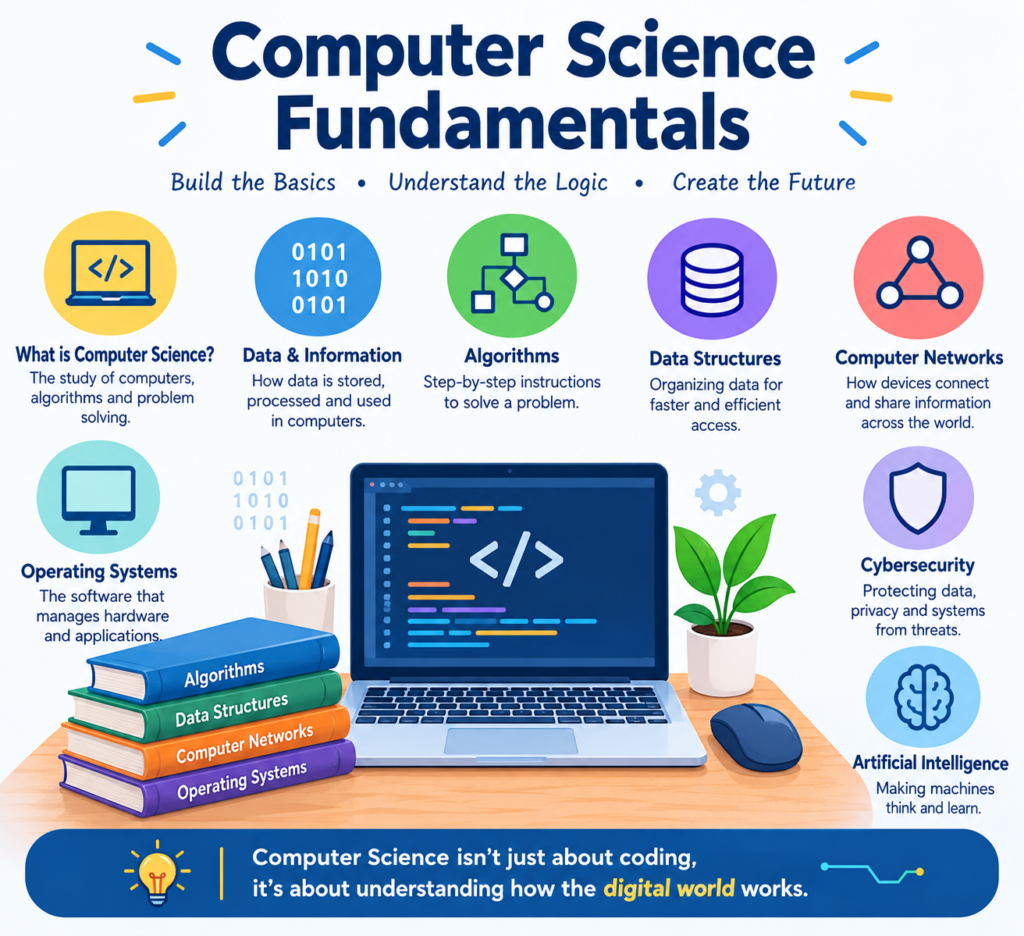
Computer science is one of the most important criteria in today’s digital world. We use computers, smartphones, websites, applications, and online services every day, but many people do not know how these technologies actually work. Computer science fundamentals provide the basic knowledge needed to understand how computers process information, how software is created, and how different digital systems communicate with each other.
Learning these fundamentals is useful not only for students but also for anyone who wants to build a career in technology.
Understanding Computers and How They Work
A computer is an electronic device that receives input, processes information, stores data, and produces output. The major components of a computer include the CPU, RAM, storage devices, motherboard, keyboard, mouse, and display.
The Central Processing Unit, is the given instructions and calculations. RAM temporarily stores information that the computer is currently using, while storage such as an SSD or hard drive keeps data for longer periods.
Computer systems also depend on two major categories: hardware and software. Hardware refers to physical components, while software consists of programs and instructions that tell the hardware what to do.
Data and Information
Data is another important computer science fundamental. Computers work with different types of data, including numbers, text, images, audio, and video.
At the lowest level, computers represent information using binary, which consists of 0s and 1s. A single binary digit is called a bit, while eight bits make one byte. Memory units include kilobytes, megabytes, gigabytes, and terabytes.
Understanding how data is represented and stored helps beginners understand how computers manage large amounts of information.
Programming Fundamentals
A computer programming language is the process of writing instructions that a computer can understand and execute. Programmers use programming languages such as Python, Java, C++, JavaScript, and others to create software and applications.
Basic programming concepts include variables, data types, operators, conditions, loops, and functions. For example, a condition can tell a program to perform one action when something is true and another action when it is false.
Learning programming also a develops logical thinking and problem-solving skills.
Algorithms and Problem-Solving
An algorithm is a step-by-step procedure for solving a particular problem or completing a task. Algorithms are everywhere, even outside computers.
For example, a recipe can be considered a simple algorithm because it provides a sequence of steps for preparing food. In computer science, algorithms are used to search, sort, calculate, process data, and solve complex problems.
Understanding algorithms helps programmers create solutions that are accurate and efficient.
Data Structures
Data structures are ways of organizing and storing data in memory so that it can be used efficiently. data structures include arrays, linked lists, stacks, queues, trees, and graphs.
Different data structures are suitable for different types of problems. For example, a queue can be useful when items need to be processed in the order they arrive.
Learning data structures along with algorithms forms an important part of computer science education.
Computer Networks and the Internet
Computer networks allow computers and other devices to communicate with one another. A network can be small, such as a home network, or extremely large, such as the Internet.
Important networking concepts include IP addresses, servers, clients, routers, and protocols. When you open a website, your device communicates with servers through a network to request and receive information.
Understanding basic networking concepts helps explain how websites, online games, video calls, and other Internet services work.
Time for an adventure
Explore our network of trails that lead through a variety of woodland habitats and observe the diverse flora that call this area home.


Databases and Data Management
A computer database is a systematic tool for storing and managing information. Websites and applications use databases to store user accounts, products, articles, orders, and other data.
Databases commonly used organize information into tables containing rows and columns. SQL, or Structured Query Language, is widely used to interact with many relational databases.
Database knowledge is especially useful for people interested in software development, web development, and data-related careers
Operating Systems
An operating system is software that manages a computer’s hardware and provides an environment for applications to run. Examples include Windows, Linux, macOS, and Android version
The operating system manages resources such as memory, files, storage, and running processes. Without an operating system, using a modern computer or smartphone would be much more difficult.
Cybersecurity Fundamentals
The primary objective of cybersecurity is to protect computers, networks, applications, and data from unauthorized access and other threats, ensuring that no one can steal our data.
Basic cybersecurity practices include using strong passwords, enabling multi-factor authentication, keeping software updated, avoiding suspicious links, and protecting personal information.
As more activities move online, understanding cybersecurity has become an important part of basic computer knowledge.
Artificial Intelligence and Computer Science
Artificial intelligence, or AI, is another major area connected to computer science. AI enables computers to perform tasks that normally require human-like capabilities, such as recognizing patterns, understanding language, and making predictions.
Machine learning is a branch of AI in which systems learn patterns from data. AI is now used in areas such as search engines, recommendation systems, healthcare, education, finance, and customer service.
Important Skills for Computer Science Beginners
A successful computer science learner needs more than programming knowledge. Logical thinking, problem-solving, mathematics, creativity, communication, and continuous learning are also valuable.
Technology changes quickly, so developing the habit of learning and practicing is important.
Career Opportunities in Computer Science
Computer science provides many career paths. Depending on their interests and skills, students can explore careers such as software developer, web developer, data analyst, cybersecurity professional, database administrator, network engineer, and AI or machine-learning professional.
Different careers require different combinations of education, technical skills, and practical experience.
How to Start Learning Computer Scienc
Beginners should start with the basics rather than trying to learn everything at once. First, understand how computers work and then learn a programming language such as Python. After that, study algorithms, data structures, databases, networking, and other areas according to your interests.
Practical projects are also extremely useful because they allow learners to apply theoretical knowledge to real-world problems.
Conclusion
Computer science fundamentals provide the foundation for understanding modern technology. From computer hardware and programming to algorithms, databases, networks, cybersecurity, and artificial intelligence, each area contributes to the way digital systems work.
For beginners, the best approach is to learn gradually, practice regularly, and build small projects. With consistent effort, these fundamentals can provide a strong foundation for further computer science education and a variety of technology-related careers.